Australia,
Aboriginals
& the Didgeridoo
by Darren Liebman
(copyright July 2005)
Imagine a
mysteriously diverse and beautiful land on the entirely other side of the
planet ...
A land of endless coastline, vast deserts, verdant forests and towering cliffs
...
A land containing some of the most unique and varied wildlife on earth ...
A land that's been inhabited for many thousands of years by a mystical, nature-loving
people ...
A land that produces an instrument called the didgeridoo, which sounds and
looks as exotic as its name ...
A Land Down Under ...
A land called Australia!
AUSTRALIA:
The Land
... is an island, country and continent located between the South Pacific
and Indian Oceans in the area of the world known as Oceania. It's the world's
largest island, the only island continent, and the only country that's a continent.
It's the world's sixth largest country, but is the smallest continent, followed
by Europe, Antarctica, North America, South America, Africa and Asia.
... is nicknamed The Land Down Under because it's located entirely in the
Southern Hemisphere. It is named after the Latin word australis, which means
"southern." It was once connected to what is now known as Antarctica,
via the super-continent Gondwana; about 50 million years ago, it separated
and drifted north. Because Australia and North America are located in opposite
hemispheres, their seasons are reversed. Australia's east coast is 14 hours
ahead of Florida.
... is about the same size as the United States, minus Alaska and Hawaii,
but has far fewer people. Australia, the world's sixth largest country, is
home to approximately 20 million people, according to 2005 projections, while
the U.S. has a population of about 300 million. Eighty percent of Australia's
population lives along the coast.
... is the earth's flattest and driest continent, but includes a wide array
of terrain: desert, mountains, swamps, rain forest (about one percent of the
continent) and about 22,000 miles of coastline (more beaches than any other
country). The vast desert area that takes up much of central and western Australia
(about a third of the continent), including the Simpson, Gibson, Great Sandy
and Victoria Deserts, is nicknamed the "outback." Uluru, a.k.a.
Ayers Rock, the famous free-standing rock that sits near the country's center,
is the world's second-largest monolith, measuring 1,000 feet high, 2.2 miles
long and 1.5 miles wide. The tallest mountain is 7,310-foot Mount Kosciuszko,
located in the Snowy Mountains range, New South Wales. The world's largest
coral reef domain, the Great Barrier Reef, extends about 1,245 miles along
the northeast coast. Australia's major rivers are the Murray and the Darling.
... comprises six states - New South Wales, Queensland, South Australia, Tasmania
(an island off the eastern-southern coast), Victoria and Western Australia
- and two mainland territories, Australian Capital Territory and Northern
Territory. Australia has several overseas territories, including two in Antarctica.
... has five cities of more than 1 million people each, as of 2004: Sydney,
Melbourne, Brisbane, Adelaide and Perth. Its capital, however, is Canberra,
located in the Australian Capital Territory. Other well-known cities include
Darwin, Kimberley, Cairns, Hobart and Alice Springs. About 80 percent of Australia's
population is located in the southeast, which includes Sydney, Melbourne and
Canberra.
... has a tropical/warm climate year-round in the northern regions. The rest
of the country is warm during the summers and cool during the winters. The
Aussie interior gets extremely hot during the summer, with temperatures sometimes
exceeding 110 degrees Fahrenheit.
AUSTRALIA: Human History
... has two indigenous peoples: the Aboriginals and the Torres Strait Islanders.
Although these two cultures share many traits and traditions, they are distinct
ethnic groups. Just as our Native Americans were the first guardians of North
America, the Aborigines and Torres Strait Islanders are the original custodians
of Australia. The Aboriginals migrated to Australia so long ago - 40,000 to
70,000 years ago - that the millennium date of their arrival is unknown.
... was first settled by Europeans in 1788, when 780 British convicts arrived
by ship near present-day Sydney. Many of the prisoners were shipped to Australia
for offenses such as speaking out against the government and being unable
to pay back loans. The first free settlers arrived in 1793.
... since 1901, has evolved from a colony of the United Kingdom to an independent
and sovereign democratic nation. Australia Day (Jan. 26) is an annual celebration
of Australia's nationhood, commemorating the ceremonious unfurling of the
British flag at the head of Sydney Cove by Governor Arthur Phillip in 1788.
Many Australians, however, have termed Australia Day as Invasion Day, in reference
to the ensuing Aboriginal subjugation.
AUSTRALIA: Wildlife and Nature
Australia is one of the world's 17 mega-diversity countries, according to
Conservation International. It is home to about 280 species of mammals (including
150 types of marsupials, more than any other country), 750-plus species of
native birds, and about 700 species of reptiles, including 140 types of land
snakes, 30 sea snakes and 370 lizards.
Despite its abundance of unique fauna and flora, Australia, just like Florida,
has suffered ecological and environmental damage due to non-native species
of animal and plants either escaping or being released into the wild. The
dingo, Australia's wild dog, is believed to have been the first non-native
animal Down Under. Although dingoes did, and still do, cause environmental
damage, Australia was quite ecologically balanced until the late 1700s, when
the first English settlers arrived and introduced a slew of non-native, havoc-wrecking
creatures.
They brought sheep, cattle, goats, pigs and rabbits for food; cats and dogs
for pets; foxes and deer for hunting; and horses and camels for transport
and exploration. These animals led to overgrazing, land erosion and predation
of natural species. Many of these animals escaped and became feral.
But that was just the beginning of Australia's intrusive animal problems.
Europeans later imported herds of water buffalo and deer for hunting and food,
cane toads for insect control, and many more. Non-native predation of indigenous
species, along with habitat destruction and water-supply fluctuation, has
resulted in Australia having the world's highest mammalian extinction rate,
according to National Geographic.
Florida also suffers environmental problems due to both feral and non-native
animals. LESSON: Do not release any animal, either wild or tame, that does
not already occur in the environment!
Words to learn
*fauna - n. the animals of a specified region or time.
*flora - n. the plants of a specified region or time.
*carnivore - n. any flesh-eating animal or plant.
*herbivore - n. animal that feeds on plants.
*omnivore - n. animal that feeds on both flesh and plants.
*ecology - n. study of the relations of organisms to one another and to their
physical surroundings. Also: the study of the interaction of people with their
environment.
*environmentalism - n. work related to protection of the natural environment.
*indigenous - adj. refers to people, plants or animals originating naturally
in a region. (Australian example: saltwater crocodile; Floridian example:
American alligator)
*endemic - adj. refers to plants or animals, and sometimes customs and diseases,
native to a particular country, nation or region. (Australian example: platypus;
Floridian example: Florida panther)
*feral - adj. refers to any non-native animal that has escaped from captivity
and established self-sustaining population independent of humans. In Australia,
wild horses, pigs and cats are feral, while foxes and rabbits are not as these
latter two animals were deliberately released to establish wild populations.
However, "feral" is now generally applied to any non-native animal
that causes serious damage to human interests.
Dingoes are a good example of Australian feral animals. They were originally
brought to Australia by Asian seafarers - probably ancestors of today's Aborigines
- about 3,500 years ago. Aboriginal people used dingoes for food, companions,
hunting aids and bed warmers, but many dingoes escaped into the wild and disrupted
the ecology by killing native wildlife.
Domestic dogs were brought to Australia by Europeans in 1788 and their release
into the wild has continued since. Dingoes and other wild dogs are widely
distributed throughout the country and are present in most environments. (The
dingo is increasingly crossbreeding with the domestic dog.)
In the U.S., cats and hogs are among the worst feral pests. In large part
due to irresponsible pet owners, tens of millions of cats live wild in our
country, killing hundreds of millions of songbirds, reptiles and mammals.
Feral hogs tear up landscapes and vegetation and eat native plants and animals.
*exotic - adj. refers to any organism (either tame or wild) that is outside
its natural range. It may be an animal that has been introduced from another
country, or it may be an animal that has been translocated to another part
of a country. For example, kookaburras have been introduced to south-west
Western Australia. Some synonyms of exotic, in the context used above, are
non-native and introduced.
*invasive - adj. refers to any organisms (usually transported by humans),
which successfully establish themselves in, and then overcome, otherwise intact,
pre-existing native ecosystems. Invasive species are a major threat to biodiversity
(the collected wealth of the world's species of plants, animals and other
organisms) as well as to agriculture and other human interests.
Invasive creatures in Florida include many species of retiles and fish, as
well as the nutria (a large South American rodent) and fire ants. According
to National Geographic, Florida spends about 50 million dollars a year just
to control invasive plants, such as Australian melaleuca! Synonym for invasive:
alien.
*extinct - adj. no longer in existence. As of the year 2000, 18 species of
native Australian mammals had become extinct in the previous 200 years and
22 other species were listed as being in danger of extinction. One beautiful
animal thought to have become extinct is the thylacine, a.k.a. Tasmanian tiger,
a dog-like marsupial. The thylacine disappeared from the mainland with the
introduction of dingoes about 3,500 years ago and was then hunted to extinction
in Tasmania. The last known specimen died in 1936.
*species - n. category in the classification of living organisms consisting
of similar individuals that can produce fertile offspring only when they mate
within their group. Related species make up a genus; related genera make up
a family; related families make up an order; related orders make up a subclass;
related subclasses make up a class; related classes make up a subphylum; related
subphyla make up a phylum; related phyla make up a kingdom.
*amphibian - n. any of a class of cold-blooded, scaleless vertebrates. Amphibians
including frogs, toads, newts and salamanders, which usually begin life in
the water as tadpoles with gills and later develop lungs. Most amphibians
live both on land and in water. Frogs, which are different than toads, are
the only group of amphibians found naturally in Australia. In 1935, in a glaring
ecological blunder by humans, the cane toad was introduced to the state of
Queensland to eat beetles that damaged sugar cane. However, the toads did
not control the beetles and ate almost any small creatures they could catch.
Just as disastrous, its eggs, tadpoles and adults are all poisonous, and many
native animals and domestic pets have died after mouthing or eating cane toads.
*bird - n. any of a class of egg-laying, feathered vertebrate with a beak,
two wings, and two feet, and usually able to fly. Australia is home to about
750-plus native species of birds, including two of the world's largest, the
emu and the cassowary, both of which are flightless. The wedge-tailed eagle
is Australia's largest bird of prey.
*invertebrate - n. animal without a backbone, including (but not limited to)
insects, spiders, scorpions, centipedes, millipedes, crayfish, crabs, crustaceans,
mollusks, sponges and echinoderms. Ninety percent of the world's creatures
are invertebrates. Just among insects, there are about one million known species!
There are roughly 25,000 species of spiders, 2,000 of which live in Australia
and several of whose bite can be fatal to humans.
*mammal - n. any of a large class of warm-blooded vertebrate that secretes
milk for nourishment of its young. Class Mammalia is divided into three subclasses:
monotremes, marsupials and placental mammals.
*marsupial - n. any of an order of mammals born incompletely developed, hairless
and blind. A baby marsupial climbs to its mother's belly and attaches itself
to a nipple, then suckles milk until it's ready for independence. Many female
marsupials have belly pouches that shelter their young. Australian marsupials
include kangaroos, koalas, wombats, wallabies, possums, numbats, bandicoots
and the Tasmanian Devil. (North America's only marsupial is the possum, which
is a different species than its Aussie cousins.)
*monotreme - n. any of the lowest order of mammals that lay eggs and have
a single opening for the digestive and urinary tracts and genital organs.
The world's only monotremes are the platypus and the long-beaked and short-beaked
echidnas (spiny anteaters). The platypus is endemic to Australia; the short-beaked
echidna is found Down Under and in New Guinea; and the long-beaked echidna
is found only in New Guinea.
*placental mammal - n. mammal that that grows inside the mother's body until
it is well developed and then can suckle milk from its mother's nipples when
it is hungry. Humans, dogs, cats, apes, dolphins and thousands of other mammal
species are placental.
*reptile - n. any of a class of cold-blooded, scaly animals that includes
snakes, lizards, crocodiles, tortoises and turtles. Australia is home to about
700 species of reptiles. While many Australian snakes are venomous - 20 species,
including the northern death adder, brown, taipan and tiger snakes, produce
venom that can kill a human - all of its lizards are non-venomous.
*marine - adj. of, found in or produced by the sea. Oz has more coastline
than any other country, and its waters contain an amazing array of life, including
3,600-plus fish species and mammals such as dolphins, dugongs (similar to
manatees), seals, turtles and whales. The Great Barrier Reef, made up of about
2,800 separate reefs covering 135,000 square miles along the northeast coast,
is home to 2,000 fish species and 350 types of coral. But Australia's waters
can be as dangerous as they are kaleidoscopically beautiful. Among the potentially
deadly creatures are sharks, sea snakes, stone fish (world's most venomous
fish), cone shells, the saltwater croc, the blue-ringed octopus and, perhaps
most dangerous of all, box jellyfish - arguably the most venomous animals
on the planet. Box jellies are found in the coastal waters of northern Australia
and have been documented with killing about 70 people. Fortunately, many beaches
use nets to keep box jellies out of swimming areas. Nets are also used along
some New South Wales beaches, including many in and around Sydney, to protect
swimmers from sharks.
*symbiosis - n. close existence and interaction of two different species,
usually to the advantage of both. For instance, termites eat wood and other
plant matter. In the termites' guts are tiny organisms that break down tough
plant fibers. Sometimes, however, the symbiotic relationship favors one of
the species, to the detriment of the other. This is sometimes the case with
termites and Australian eucalyptus trees; termites sometimes live in these
trees and help fertilize the nearby ground with their droppings, but they
also damage the trees by eating part of it. Most traditional Aboriginal didgeridoos
are made from termite-hollowed euc trunks.
Unique
creatures ...
*emu - second largest bird in the world, behind the ostrich; too large to
fly, but can run as fast as a galloping horse (about 30 mph); female emus
lay the eggs - one of which can be about 12 times as large as a hen's eggs
- but male emus sit on the eggs until they hatch and then care for the young;
live everywhere but the very top of Australia; adult height is 5 to 6.5 feet.
*frilled dragon (frill-neck lizard) - has folds of skin that form a large,
colorful, fan-like collar around its head; when frightened, opens its mouth
and makes a loud hissing noise as the frill opens up like an umbrella; if
need be, can travel very quickly on its two hind legs; eats mainly insects,
but will eat other lizards; grows to 28-35 inches long; lives in northern
Australia.
*kangaroo - more than 40 species of this marsupial live Down Under, from small
tree kangaroos, which live in north Queensland's mountain rainforests and
can weight 13-16.5 pounds, to the red 'roo, which can be as tall as a man
and weigh 180 pounds; karoos have exceptionally powerful rear legs for hopping:
te Eastern grey kangaroo has reached bounding speeds of 40 mph and jumped
nearly 44 feet in length, while the red has jumped more than 10 feet vertically.
*koala - marsupial that eats almost exclusively the leaves of certain eucalyptus
trees; diet is so low in energy that it sleeps up to 20 hours a day and rarely
leaves safety of tree; name "koala" means "no drink" in
certain Aboriginal languages, because koalas obtain most of their water from
eucalyptus leaves; only mammal, other than the greater glider and ringtail
possum, which can survive on a diet of eucalyptus leaves; has rear-opening
pouch, like wombat; is not a bear; lives in eucalypt forests of eastern Australia;
adult weight is 24-26 pounds.
*kookaburra - two species of this bird are the blue-winged kookaburra and
the laughing kookaburra; the laughing kookaburra the is better-known and larger
of the two - it can grow to more than 17 inches long and is often heard letting
loose a loud, chuckle-like call; its cry is often imitated through the didgeridoo;
while the blue-winged kookaburra prefers to hunt over water, the laughing
kookaburra usually hunts on land for insects, frogs, reptiles and rodents.
*platypus - one of only three egg-laying mammals on earth, it has a bill and
webbed feet like a duck and waterproof fur like a seal; the male has venomous
spurs in its hind ankles; walks with a lizard-like gait; has been around since
the time of dinosaurs, more than 100 million years ago; adults weigh 1 ½
to 6 pounds; eats crayfish, worms, shrimp and insects; spends almost all of
its life underground or underwater, in or near fresh water along the east
coast of the mainland and in Tasmania.
*saltwater crocodile - world's largest members of the crocodilian family;
has reached 23 feet in length and is considered extremely dangerous; lives
in estuaries, rivers, swamps, floodplains and the sea of northern Australia;
was almost hunted to extinction before becoming a protected species in 1972;
smaller, freshwater crocs can also be found Down Under; one of the most notable
differences between crocodiles and alligators is that when a croc's mouth
is closed, its lower canine teeth can still be seen, while a gator's teeth
are hidden when its mouth is closed.
*short-beaked echidna - also known as spiny anteater; one of only three species
of egg-laying mammals, called monotremes (others are platypus and long-beaked
echidna, the later of which exists only in New Guinea); found throughout Australia
in bush; weighs between 4 1/2 and 15 pounds.
*Tasmanian devil - Australia's largest marsupial carnivore; was common on
mainland until about late 1500s, but today is only found in island state of
Tasmania; nocturnal, hunts from dusk to dawn for dead animals, insects and
small mammals; has aggressive temper when cornered or threatened, but is not
considered dangerous to humans or their domestic animals; weighs 15-20 pounds.
*water-holding frog - in dry conditions, this frog digs a burrow at the foot
of a bush or tree and hibernates; its bladder serves as a storage tank for
water and shed skin forms a water-saving cocoon; after rain falls, the frog
surfaces, sheds the cocoon, feeds and breeds; was used as a water source Aborigines;
lives in the arid inland of Australia near waterholes and swamps that fill
after rain.
*wombat - burrowing, plant-eating marsupial resembling a small bear; two species
include the common wombat and the Southern hairy-nosed wombat; has rear-opening
pouch, like koala; when disturbed or annoyed, kicks backward with both hind
feet.
AUSTRALIA:
Random Info
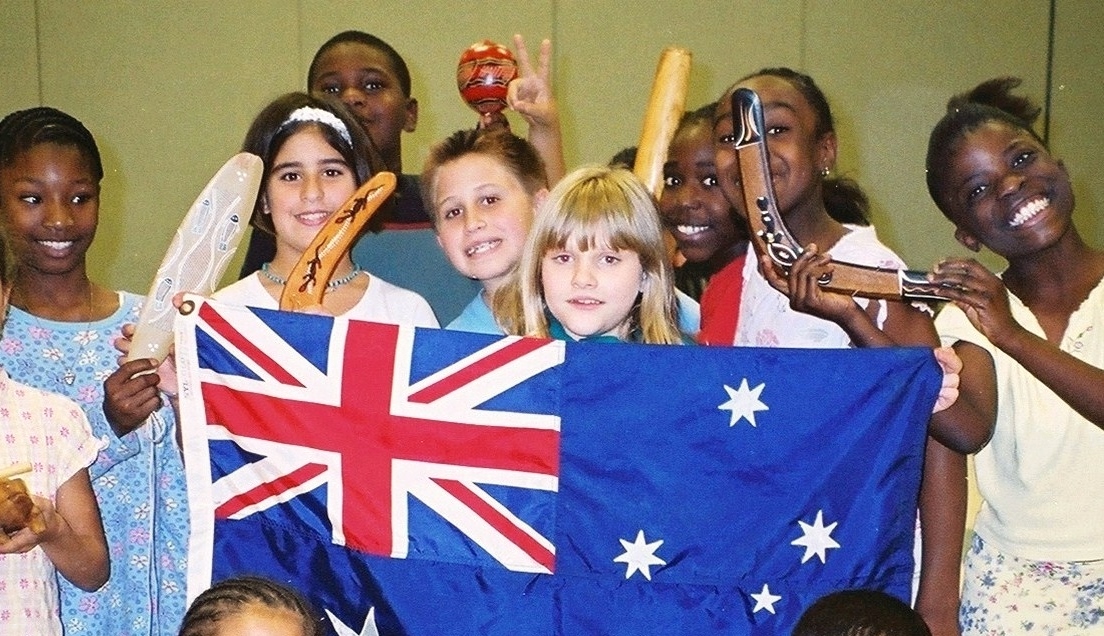
*The Australian flag is composed of three parts: the Union Jack (British flag),
representing the initial European colonization by Britain, in the top left
corner; the seven-pointed 'Star of Federation', representing Aus' six states
and all its combined territories, in the bottom left corner, and the Southern
Cross constellation, which can be seen from all of Australia's states and
territories, taking up the right half.
*The Australian dollar is its monetary unit. Its major exports include wool,
beef, lamb, coal, gold and iron ore.
*The most popular sports Down Under include cricket, rugby, Aussie Rules football,
basketball and, of course, all water sports.
Some unique
words ...
*bananalander - native of Queensland
*barbie - barbeque
*beauty! - excellent!
*billabong - waterhole
*bloke - a guy
*bludger - shirker, freeloader
*bush - rural area
*bush tucker - wild edibles
*cossie - bathing suit
*dunny - outhouse
*fair dinkum - honest
*footy - Australian National Football
*g'day - good day
*greenie - environmental activist
*hoon - fool or idiot
*jackeroo - stockhand
*lollies - candies
*mate - buddy
*ocker - rough and uncultivated Australian man
*on the dole - on welfare
*ripper! - terrific!
*ropeable - angry
*sheila - Australian woman
*squatter - gentleman rancher
*station - ranch
*swag - possessions carried by a traveler in the bush
*tucker - food
THE ABORIGINALS
... have one of the oldest cultures on earth. Many scientists believe the
ancestors of present-day Aboriginal people arrived in Australia from southeast
Asia, via New Guinea, during the low sea levels of the most recent ice age,
between 40,000 and 70,000 years ago! They probably traveled in small boats
and rafts and walked across pieces of land that once bridged the continents.
However they arrived, it was so long ago that the exact millennium has never
been pinpointed.
... traditionally do not call themselves Aborigines. Different groups have
different names, depending on which languages they speak and where they live.
For example, the Koori people come from the Koori lands, in the modern-day
states of Victoria and New South Wales, while the Murray people live in present-day
Queensland. Instead of using the names, however, the first European settlers
called all the original peoples Aborigines. "Aborigine" is derived
from the Latin term ab origine, which means "from the beginning."
Aborigines also often refer to themselves as Aboriginal people(s) or Aboriginal(s).
... are very connected - physically and spiritually - with the land and sea,
and all the creatures in those environments. A common Aboriginal expression
is "The land is my mother."
... believe spirit ancestors at the beginning of time created the world, all
its creatures and the Aboriginal way of life, and that everything, past and
present, is related. "Dreamtime" or "Dreamings" are legends
that tell of the experiences of the creation ancestors.
... are linked to the creation time and nature through their totems, which
are animal or natural objects that symbolize a family or clan. Whatever a
person's totem, he or she must learn everything about it and never destroy
or eat it. This is one of the Aboriginal ways of conserving the environment
and all its creatures.
... were once divided into at least 250 groups, with a common religion but
different customs and languages. People's lifestyles varied a great deal,
depending on where they lived. Desert tribes moved often, over a wide area,
in search of water and food. Groups in wetter areas stayed in a fairly small
region, moving just two or three times a year. Each tribe occupied a certain
homeland and respected the homelands of others. Permission was needed to travel
through someone else's land. More than two-thirds of today's Aboriginals live
in big cities, away from their ancestral homelands.
... still have hundreds of languages among all their different tribes. None
of these languages are written; therefore, painting, music, songs and ceremonies
became - and remain - an important means of communication, by which to pass
on traditions, laws and other information.
... have the world's longest continuing art tradition, which began as rock
art in Arnhem Land, located on the very central-northern tip of Australia.
They also would - and still do - paint on tree bark, ceremonial poles, artifacts
and their bodies. X-ray style, portraying bone structure and internal organs,
first arose about 6,000 years ago and continues to this day. Traditional colors
are red (derived naturally from ochre), yellow (ochre), white (clay or chalk)
and black (charcoal).
... used the boomerang as a hunting tool. But while many people mistakenly
believe Aboriginals used the boomerang primarily to hunt game, it was mostly
used to kill birds or to direct them into nets. In the latter situation, for
instance, when a flock of birds was spotted, an Aboriginal hunter would imitate
a hawk call. He or a hunting mate would then throw the boomerang above the
birds, which would swoop down to elude the fake hawk and fly into strategically
placed nets. Other Aboriginal hunting tools included clubs, spears and the
hunting (or throwing) stick, which was thrown from a distance to take down
large mammals or birds. A hunting stick, although similarly shaped to the
boomerang, is lopsided on one side and not meant to return. Today boomerangs
are mostly used for sport.
... had some permanent effect on the land, mostly from using fire to burn
off old grass and make way for new green growth, and to flush animals out
of the woods. This constant, controlled burning, traditionally used in small
areas, created open woodlands for kangaroos, wallabies, bandicoots and other
game, and prevented undergrowth from building up to fuel huge, ultra-destructive
wildfires. (Europeans had a much broader and detrimental influence on the
land, by cutting trees for timber, clearing land for crops and overrunning
grasslands with livestock.) In some parts of Australia, Aboriginals, other
landowners and national park rangers are returning to the use of "firestick
farming" to prevent violent summer bushfires.
... experienced many of the same cultural challenges, indignities and atrocities,
at the hands of the white settlers, as did our Native Americans and African-Americans,
including racism, oppression, segregation and decimation. There may have been
between 500,000 and one million Aboriginals at the time of European settlement
in the late 1700s; as of 2004, there were about 350,000, which was less than
two percent of Australia's total population. Most of today's Aborigines are
of mixed Aboriginal and white descent.
... had complex cultural, political and economic rules and edicts, but Europeans
did not initially understand or appreciate these elaborate social systems.
Most European colonists considered the Aborigines primitive and inferior,
partly because of their dark skin and the fact that they didn't have any native
written languages. (The Aboriginals communicated orally and through music
and art.)
... became Australian citizens in 1947, yet didn't gain equal voting rights
throughout the land until 1965, when Queensland became the last Aussie state
to pass equal suffrage laws. In 1971 Neville Bonner became the first Aboriginal
to sit in any Australian Parliament. Yet even today many Aboriginals still
face discrimination and prejudice, and are underprivileged economically, socially
and politically.
... have had many inspirational leaders and role models, including land rights
pioneer Eddie Mabo; author/public speaker/inventor David Unaipon; didgeridoo
maker/player Djalu Gurruwiwi; track star Kathy Freeman; tennis player Evonne
Goolagong; and Tasmanian survivor of brutality Truganini. (See accompanying
"Aboriginal Heroes" for more information on these amazing people.)
... have their own distinct flag, designed by Aboriginal artist Harold Thomas
in 1971. The flag is designed with a black top half to represent the Aboriginal
people; a red bottom half to represent the earth and the Aboriginals' spiritual
relationship to the land; and a yellow sun in the middle, symbolizing the
giver of life.
... can teach us all how to better live in harmony with the environment and
all of its creatures, and perhaps even more importantly, how to live in harmony
with ourselves.
THE DIDGERIDOO
& ABORIGINAL MUSIC
Have you ever heard "Survivor" or an Aussie-theme commercial and
wondered what is the enchantingly strange sound - "waowaowaow" -
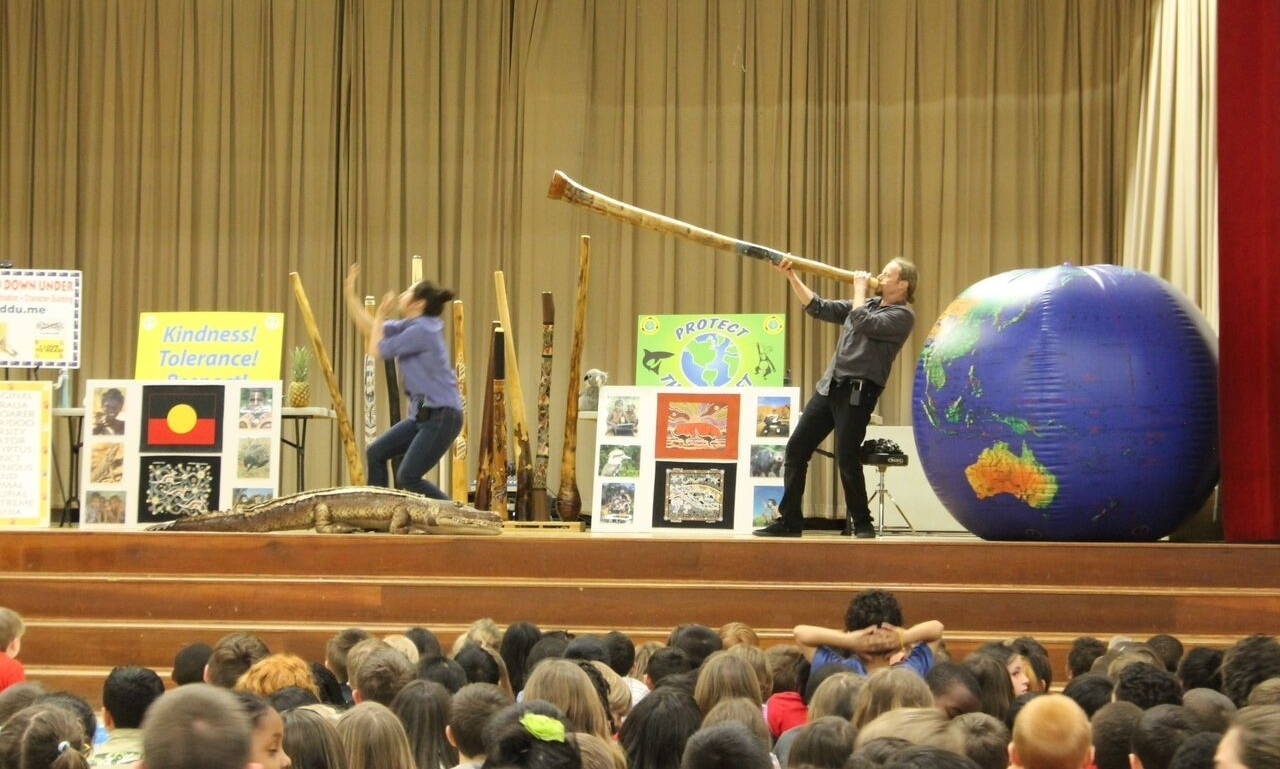
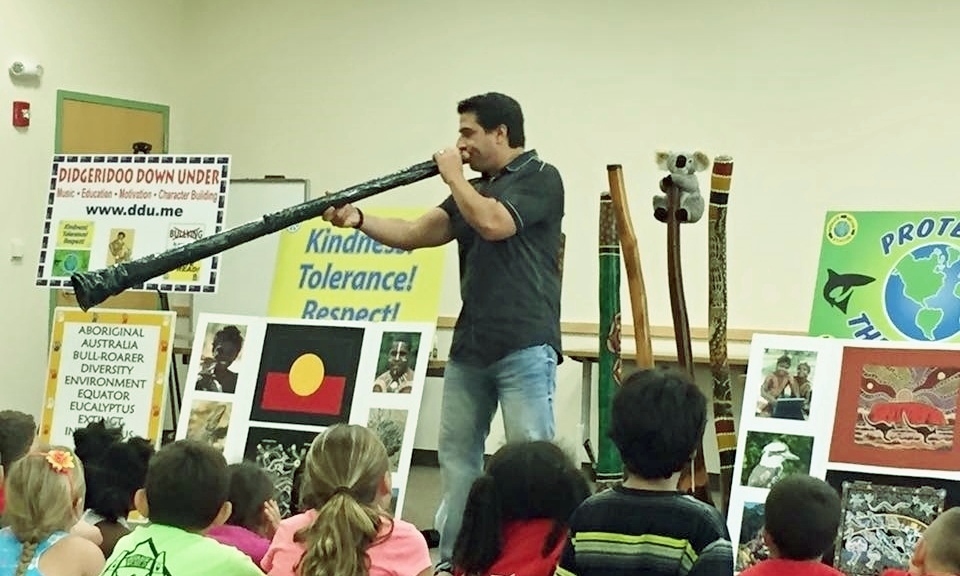
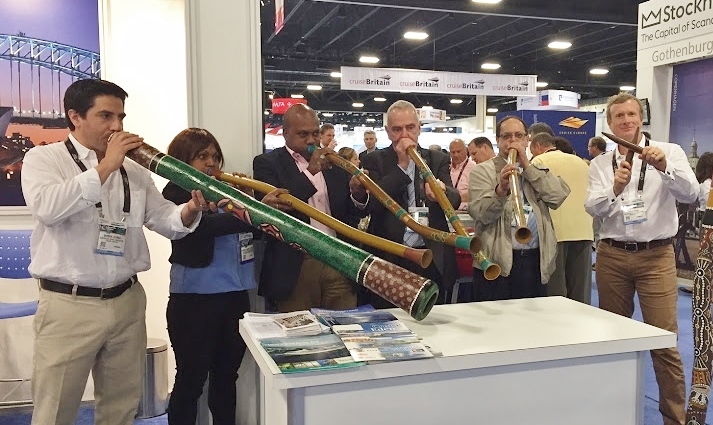
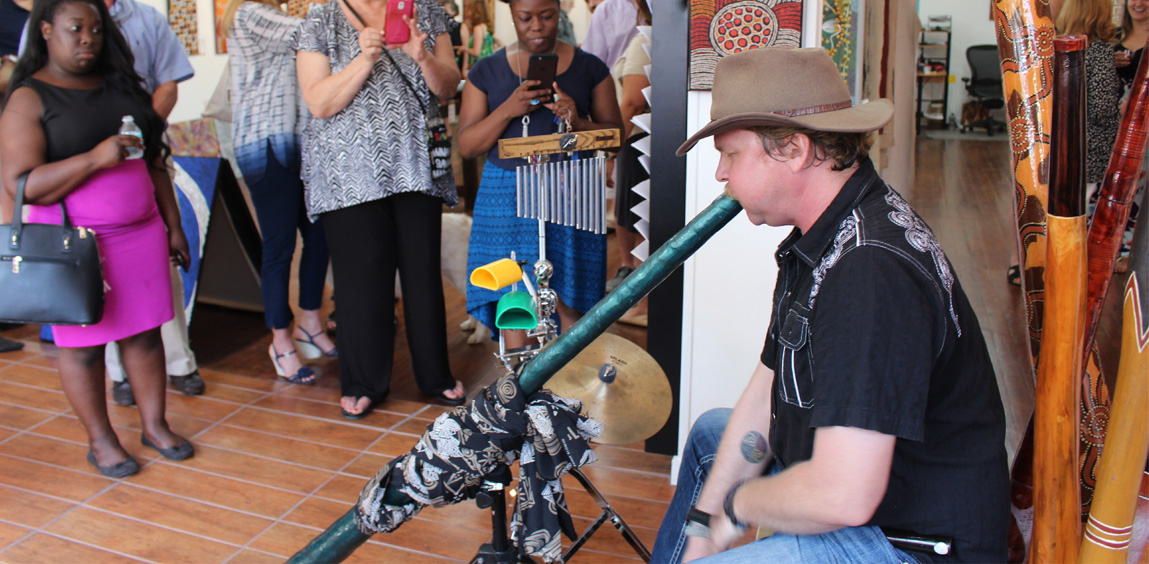
in the background? Mate, it's the didgeridoo, an Australian Aboriginal aerophone
woodwind instrument that sounds and looks as exotic as its name.
*Essentially a hollowed-out tree branch, the didgeridoo, a.k.a. didg, is among
the world's oldest instruments, and it produces a dynamic range of otherworldly
sounds and tones. Besides being played solo, the didgeridoo is also used to
accompany singing, dancing, chanting, drumming and almost all other forms
of music, and for various types of therapy.
*The didgeridoo is best described as a simple instrument played with much
complexity. It is a one-note instrument that can be played up or down by half
a pitch according to mouth aperture. An experienced player will use everything
from his or her lips, tongue, cheeks, throat, vocal chords and diaphragm to
coordinate sounds, rhythm and breathing.
*The inception of the didgeridoo, which occurred thousands of years ago (between
2,000 and 40,000 or more years ago, depending on which source you ask), is
mostly associated with the Aboriginal tribes of Arnhem Land in Northern Australia.
Since then, the didg has spread among many Aboriginal tribes, and around the
world.
*"Didgeridoo" is actually an English onomatopoeic word, a word used
to represent the sound that early explorers thought the instrument made. Other
spelling variations include didgeridu, didjeridoo and didjeridu, or didg(e)
for short. Two of many Aboriginal terms for didgeridoo are yidaki and yirdaki.
*In Aboriginal culture, the didgeridoo is used in both ceremonies and informal
settings, often as an accompaniment to chanting, singing and dancing. Traditional
Aboriginal performances usually consist of powerful rhythms paced by one or
more singers (one of whom is the lead songman), each with a pair of sticks
or some percussion, and one didgeridoo. If a didgeridoo is unavailable, the
piece can still be performed.
*In some Aboriginal tribes, the didgeridoo is only played by men, but in most
groups, men, women and children all play it. Ceremonial didg playing, however,
is usually reserved for men.
*The Aboriginals have more than 20 native sound instruments, most of which
are percussive, such as clap sticks (clapping boomerangs can be used for the
same effect), hollow log drums, skin drums, rasps, rattles, bull roarers and
sticks that are beaten on shields. In some tribes, stones are used instead
of wood. Hand clapping and body slapping is used by singers of both sexes,
sometimes as a substitute for clap sticks. The Aboriginals have no traditional
stringed instruments, although some stringed instruments are found in contemporary
Aboriginal music. The only other native wind instrument besides the didgeridoo
is the gum leaf (folded leaf whistle).
*Most traditional Aboriginal didgeridoos start as a branch or trunk of a eucalyptus
tree that's been naturally hollowed out by termites, which nest by the trillions
in Northern Australia. After cutting the branch or trunk to an appropriate
length - most didges range between 4 and 5 1/2 feet, although some are much
larger - the crafter cleans out any remaining termites and pulp, and styles
the didg to his or her taste. He'll usually scrape off the bark and smooth
the outside before either a) decorating the didg with designs (often including
indigenous Australian animals, such as kangaroos, emus, snakes, or crocodiles),
or b) leaving the didgeridoo with a natural wooden finish. Finally, bee's
wax is sometimes placed on the blowing end to create a comfortable mouthpiece.
DIDG LINGO
*bull roarer - free aerophone instrument made of a slab of wood usually shaped
like a miniature surfboard that's attached to a long piece of chord at one
end; the performer twirls the wood via the chord, which makes an eerie sound
that Aborigines - and many other native peoples around the world - believe
is the voice of an ancestor, spirit or deity; occasionally referred to as
the "bush telephone", is used in rites-of-passage rituals of many
indigenous peoples.
*circular breathing - musical technique for continuous playing of the didgeridoo,
in which air is breathed through the nose while maintaining a drone.
*clap Sticks - Aboriginal instrument, also known as click sticks, used to
keep rhythm with the didgeridoo; boomerangs are also sometimes clapped together
in rhythm with the didg.
*corroboree - English version of the Aboriginal word caribberie, used to describe
Aboriginal ceremonies that involved singing and dancing.
*drone - continuous humming sound caused by softly vibrating the lips on the
didgeridoo mouthpiece. It's the foundation of all didg playing.
*eucalyptus - chiefly Australian evergreen tree that is favored by the Aborigines
for making didgeridoos; eucalyptus leaves are also koalas' main food source.
Australia is home to about 500 species of eucalyptus trees.
*tonguing - method of rhythm where the tip of the tongue is quickly snapped
to the front, top,
and bottom of the mouth to add texture to a rhythm.
*trill - didg-playing technique in which the player rolls the tongue (similarly
to rolling r's in Spanish dialect); turns a basic drone into an unusual, growl-type
sound.
*vocalizing - using voice to make sounds through the didgeridoo while droning.
HOW TO
(EASILY) MAKE, DECORATE & PLAY A DIDGERIDOO, BULL ROARER & CLAP STICKS
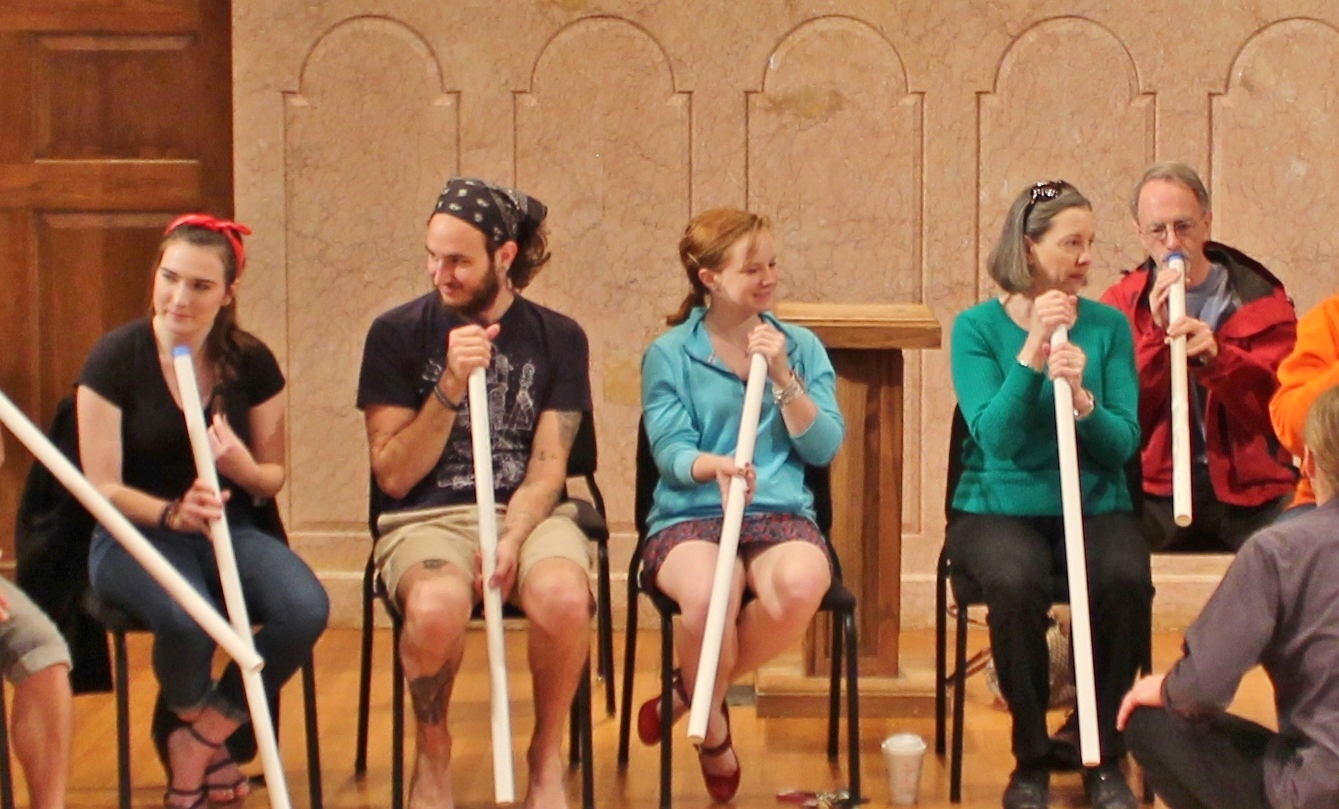
While nothing beats playing an Aboriginal-crafted eucalyptus yidaki, a didgeridoo
can be made from almost any long, hollow material, including bamboo, a carved-out
tree branch, plastic tubing, and even clay or molded leather. Although plastic
tubing, also known as PVC pipe, is synthetic, it's the cheapest and easiest
material to use and can be found at all hardware and home-improvement stores.
Perhaps PVC's greatest quality is that it can be played as soon as it's been
cut.
Another PVC benefit is that it can easily be cut to target certain notes.
The following notes can be obtained by cutting to these approximate lengths
(in inches): G = 69; G# = 65.5; A = 62; A# = 58.5; B = 55; C = 52; C# = 49;
D = 46.5; D# = 44; E = 42; F = 39.5; F# = 37; G = 35; G#= 33; and A = 31.5.
The best sizes, especially for beginners, are between 52 and 39.5 inches,
because a long didgeridoo requires much air and might sound loose, while a
very short didg will be high-pitched - a "mosquito didg" - and offer
limited tone variation. The most user-friendly PVC diameters are 1" (be
sure it's "thin-walled", which is lighter than regular-walled) and
1 ¼" ("thin-walled" is usually not available for 1 ¼").
Once the tubing has been cut, you might want to make a mouthpiece. A common
mouthpiece material is bee's wax, usually available through an arts &
crafts store or online. A solid mouthpiece should be comfortable and snug,
and not allow air to escape from the corners of your mouth. If you can't find
bee's wax, Silly Putty or Play Dough can make a temporary mouthpiece.
Finally, let your decorative imagination run wild! First, lightly scrape down
the PVC with sandpaper so that paint won't flake off. Then conjure up a decorative
theme, such as Australian animals, marine life, astronomy or whatever inspires
you. Think of the didgeridoo as a tubular painting canvas. You can even ad
texture by gluing on stones, leaves and crystals.
As for playing the didgeridoo, the basic vibrating sound, known as droning,
is made by loosely buzzing the lips inside the mouthpiece. The key is relaxation.
Slightly extend your lips as if to give someone a peck on the cheek, then
buzz the lips as if imitating a horse. If you're used to playing a brass or
woodwind instrument, concentrate on buzzing the lips looser than normal ...
because tight lips and mouth will not work! You will know if you are droning
by the tingling sensation in your lips and mouth.
(Of course, droning is just the beginning of learning how to play the didg.
For learning more advanced techniques such as vocalizing and circular breathing,
as well as more info on making and decorating a didgeridoo, Darren, Jeremy
and Lindsey are available for workshops and seminars for both kids and adults.)
To make clap sticks, carve or shave solid wood down into two, well ... sticks.
They can be any size or thickness, but they must be strong enough to take
a beating. To make a bull roarer, carve or shave wood into the shape of a
mini-surfboard (6-12 inches long). Punch a hole at one end and tie on a strong
string for twirling. Both of these accompanying instruments can be decorated
with paint.
The bull roarer produces vibration sounds as the flat object rotates in the
air. Altering the bull roarer's size and its rotational speed affects the
pitch. The smaller the bull roarer, the faster it can be twirled, resulting
in a higher pitch; a larger instrument that spins at a slower speed results
in a lower pitch. Changes in the speed and angle to the ground can produce
the sounds of a whimper, scream, moan, roar and more!
RECOMMENDED
LISTENING
There are hundreds of didgeridoo albums worldwide to choose from, including
everything from didg solos to didg mixed with world music, African drumming,
techno, ambient, symphony, rock n' roll, reggae, etc. You might not find many
of these albums in your local store, but they're definitely available on the
internet. Just type in "didgeridoo music" on a search engine, and
away you go.
These are just a few of the titles of my favorite didgeridoo players
*Adam Plack & Johnny Soames: Winds of Warning (1997)
*Alan Dargin & Gary Thomas: Didgeriduo (2000)
*David Hudson: Guardians of the Reef; Walkabout (1999); Yigi Yigi (1997)
*Dr. Didg: Out of the Woods (1994)
*Jeremy Cloakes & Ken Sands: Resonance
*Outback: Baka (1990)
*Randy Graves: Your Didjeridu Companion (2002)
*Stephen Kent: Landing (1995); Songs from the Burnt Earth (2002)
*Yothu Yindi: Freedom (1993)
*Coming soon: CDs by Didg Revolution members Lindsey Dank and Jeremy Lembo
EDUCATIONAL LESSONS & ACTIVITIES
Social Studies: Study Aboriginal culture and the hardships they've
had to overcome, similar to the United States' Native American and black populations.
Geography: Study Australia on a globe and a map. Pinpoint all states,
territories, major cities and landmarks. Learn about its diverse ecological
systems and what makes it such a unique continent. Create timelines to answer
questions (ex. Aboriginal arrival; European arrival; settlement, etc.)
Music: Construct and learn to play didgeridoos, clap sticks and bull
roarers (instructions above). Listen to and study traditional Aboriginal music
and music from other indigenous cultures.
Art: Construct and decorate PVC didgeridoos, clap sticks and bull roarers
(instructions above). Study and create the different styles of Aboriginal
art, including bark paintings, X-ray and dots.
Reading & Writing: Get acquainted with the correct meaning, spelling
and pronunciation of the Didg Lingo and other previous sections. Study and
report on any Australia-theme readings, such as those in the didgiography
(below).
Science: Learn about the animals of Australia and their unique characteristics.
Contrast the ecological problems created by non-native and feral animals Down
Under and the environmental trouble caused by similar pest animals in the
United States (especially in Florida).
Math: Compare Australia vs. U.S. by numbers / ratios for population,
miles (to/from/within Aus), land mass, coastline, beaches, highest & lowest
point, hottest & coldest place, animals (mammals, birds, marsupials, etc),
landmarks (ex. Great Barrier Reef vs. Keys reefs)
For more educational activities,
lessons and information:
*Aboriginal Art, Culture and Didgeridoo: aboriginalart.com.au/
*Australia Facts and Statistics: cia.gov/library/publications/the-world-factbook/geos/as.html
*National Geographic (world geography based on U.S. National Geography Standards):
nationalgeographic.com/xpeditions
and nationalgeographic.com/geographyaction
DIDGIOGRAPHY
(Recommended Reading)
*minimum reading level in parentheses
Aboriginal Australians: Spirit of Arnhem Land by Penny Tweedie, New Holland
Publishers, Australia, 1998. (middle school)
Blood on the Wattle by Bruce Elder, New Holland Publisher Pty Ltd., Frenchs
Forest, New South Wales, Australia, 2003. (high school)
Celebrate Australia by Ken Duncan, Ken Duncan Panographs Pty Ltd., Wamberal,
NSW, Australia, 1998. (elementary)
Dreamings: The Art of Aboriginal Australia edited by Peter Sutton, Penguin
Books Australia Ltd, Ringwood, Victoria, Australia, 1989 (middle school)
Dreamkeepers by Harvey Arden, HarperCollins Publishers, New York, 1994. (high
school)
Encyclopedia of Australian Wildlife by Steve Parish, Steve Parish Publishing
Pty Ltd., Archerfield, Queensland, Australia, 2000. (elementary)
From Alice to Ocean by Robyn Davidson and Rick Smolan, Penguin Books Australia
Ltd., Ringwood, Victoria, Australia, 192. (middle school)
Mutant Message Down Under by Marlo Morgan, HarperCollins Publishers, New York,
1994. (middle school)
National Geographic maps. (elementary)
Pheasant and Kingfisher by Catherine Berndt, Mondo Publishing, New York, 1994.
(elementary)
The Aboriginal Peoples of Australia by Anne Bartlett, Lerner Publications
Company, Minneapolis, 2002. (elementary)
Voices of the First Day by Robert Lawson, Inner Traditions International,
Rocherster, Vermont, 1991. (high school)
Additional
research material:
The Oxford Essential Dictionary, American edition, Oxford University Press,
Inc. New York, 1998.
The World Book Encyclopedia, 2003 edition.
Webster's New World College Dictionary, fourth edition, Wiley Publishing,
Inc. Cleveland, Ohio, 2002.